
You recognize the formula when it is on the page. Then you close the book, start a practice question, and your mind goes blank. This usually happens because recognition feels like memory even when you cannot retrieve the formula independently.
To memorize formulas reliably, you need to do more than reread a formula sheet. You need to understand what each formula describes, recall it without prompts, use it in problems, and return to it over several study sessions. The aim is not simply to recite symbols. It is to know which formula applies, rebuild it when possible, and use it correctly.
Start with meaning, not the exact symbols
Before trying to memorize a formula, translate it into ordinary language. Take the kinetic energy formula, KE = ½mv². You might say: kinetic energy depends on mass and on the square of velocity. That sentence gives the symbols a relationship you can reason about.
Next, identify each variable, its units, and what happens when it changes. If velocity doubles, the velocity term becomes four times as large because it is squared. If mass doubles while velocity stays constant, kinetic energy doubles. These checks turn a string of letters into a model of how quantities behave.
You should also note the conditions under which the formula works. A formula may assume constant acceleration, a right-angled triangle, an idealized system, or a particular definition of a quantity. Remembering those conditions helps you avoid choosing a familiar formula for the wrong problem.
When a formula can be derived from something you already know, practice that derivation. You may still want direct recall during a timed exam, but derivation gives you a backup route when memory fails. Focus on the key steps rather than memorizing every line of the derivation as another script.
Build a useful formula record
- Name it. Write what the formula calculates, such as compound interest, electrical power, or the area of a circle.
- Explain the variables. Record what every symbol means and include the relevant units.
- State the conditions. Add any assumptions or limits that determine when the formula applies.
- Show one rearrangement. Practice making a different variable the subject instead of memorizing every possible version.
- Add a small example. Use simple values to show how the formula works in an actual calculation.
- Mark common errors. Note details you repeatedly miss, such as a negative sign, a squared term, or a required unit conversion.
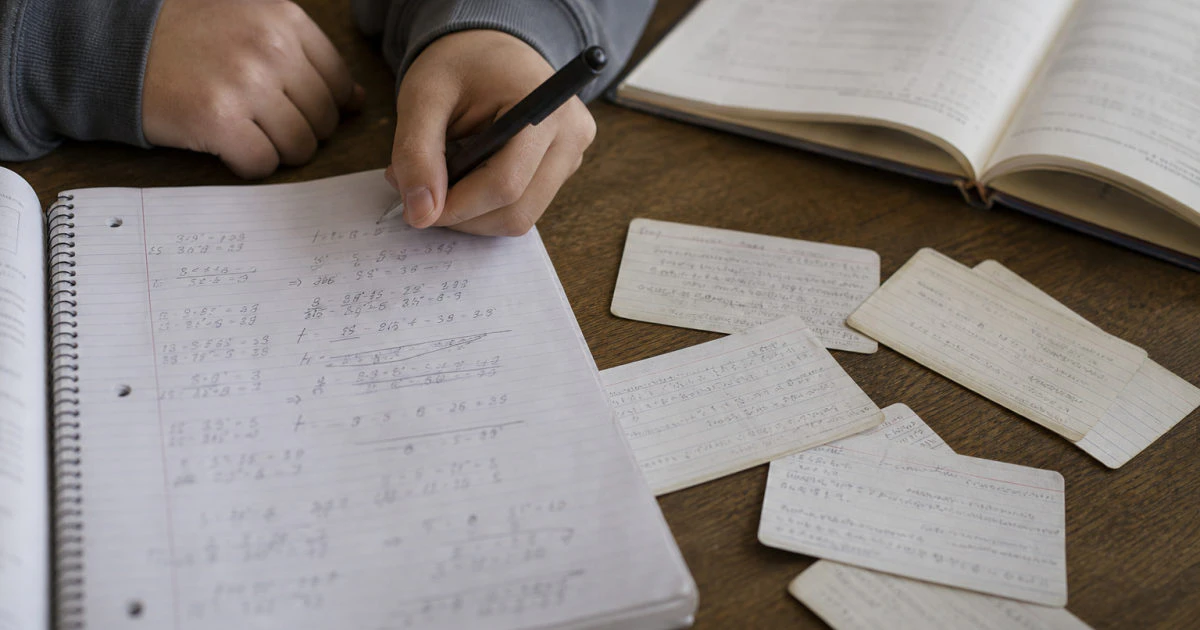
Recall the formula before you look
Once you understand a formula, close your notes and try to write it from memory. Do not copy it several times while looking at it. Copying mainly practices copying; it does not tell you whether you can retrieve the formula when the page is gone.
Use a simple cycle: read the formula, cover it, write it, check it, and correct it. After checking, hide the correct version and try again from the beginning. Pay attention to the specific part that failed. If you omitted a square or reversed two terms, create a short reminder based on the meaning of that part.
Your prompt should test more than the final equation. One side of a card might ask, “How do you calculate kinetic energy, what does each variable mean, and what are the units?” Another card could give the equation and ask you to explain what happens when velocity doubles. A third might present a short situation and ask which formula applies.
This variety matters because an exam rarely asks you to reproduce an isolated formula with no context. You usually have to recognize the type of problem, select the relationship, rearrange it, substitute values, and interpret the answer. Your recall practice should include those decisions.
Attach each formula to problems
A formula becomes easier to remember when you use it as part of a complete solution. After recalling it, solve a short problem without following a worked example. Then check both your formula choice and your calculation.
Begin with a straightforward question that clearly signals the relevant formula. Move next to a question that requires rearranging it. Then try a mixed set in which the formula is not named. Mixed practice makes you decide what information matters rather than automatically using whichever equation appears at the top of the page.
If you choose the wrong formula, do not write only “wrong” beside the answer. Record why your choice did not fit. Perhaps the question involved constant acceleration, but you selected an equation that required a missing variable. Perhaps you confused circumference with area. Explaining the mismatch trains formula selection, which is separate from memorizing the symbols.
You can also work backward from a completed answer. Cover the method, inspect the question, and predict the formula and first step. This is useful when you do not have time to complete every calculation, although it should not replace full problem solving.
Use a short spaced practice routine
- First review. Recall the new formula later in the same study session, then use it in one simple problem.
- Next session. Test it again before opening your notes. Include one rearrangement or a question that changes the usual format.
- Later reviews. Mix it with older formulas from the same course so you must choose between similar options.
- After an error. Schedule another attempt rather than assuming the correction is now secure.
- Before the exam. Prioritize weak formulas and mixed problems instead of repeatedly reviewing formulas you already retrieve easily.

Diagnose why a formula keeps disappearing
If one formula repeatedly slips from memory, identify the exact failure. “I forgot it” is too vague to guide your next attempt. Did you forget the whole structure, confuse it with a similar formula, lose a constant, reverse the numerator and denominator, or fail to recognize when it applied?
For similar formulas, compare them directly. Put them side by side and explain why they differ. Highlighting every difference is less useful than connecting each difference to meaning. For example, distinguish formulas for a circle’s area and circumference by describing whether you are measuring the surface inside the boundary or the distance around it.
For missing signs, powers, and constants, test whether the formula makes sense without them. Units can sometimes expose an error because the dimensions of your result will not match the quantity you are trying to calculate. Extreme-value checks can also help: ask what the formula predicts when a variable becomes zero, doubles, or grows very large.
Mnemonics can support recall, but use them carefully. A mnemonic may help you remember an order or group of variables, yet it should not replace understanding. If the mnemonic is more complicated than the formula, skip it.
Make your formula sheet a testing tool
A long formula sheet can create the illusion that you have organized the topic without showing whether you know it. Turn the sheet into a test by covering one column at a time. Look at the formula name and produce the equation, or look at the equation and explain its purpose, variables, units, and conditions.
Mark each formula according to what happened during closed-book recall. Keep the categories practical: correct and quick, correct but hesitant, or incorrect. Spend most of your next session on the hesitant and incorrect groups. A formula you recalled immediately does not need the same attention as one you reconstructed only after several hints.
Keep your final sheet compact enough to scan, but do not shrink it into unexplained symbols. If you cannot explain an entry, the sheet is not finished. The most useful version reflects your own errors and includes the distinctions you personally tend to miss.
Keep reading
- practice active recall in math and other problem-based courses
- write flashcards that test retrieval instead of recognition
- set up a simple spaced repetition routine without an app
If your formulas are inside a PDF or set of notes, use AtomAI Study to turn the document into flashcards, then edit the cards so they test meanings, conditions, rearrangements, and problem selection. Try AtomAI free
To memorize formulas you keep forgetting, stop treating them as isolated lines of symbols. Explain each relationship, retrieve it with your notes closed, apply it to varied problems, and review it again after time has passed.
When you make an error, classify it and adjust your practice. Understanding gives the formula structure, active recall makes it available, and problem solving teaches you when to use it. Together, those habits make your memory more dependable than repeated rereading.