
If your exam is tomorrow, being told you should have started earlier is not useful. Cramming can help you cover essential material when time is short. But if you need to remember that material beyond the exam, spreading your study out is usually the better choice.
The honest comparison of cramming vs spaced repetition is not “lazy students versus organized students.” It is a comparison of two ways to distribute your effort, with different benefits and limitations. Your deadline matters, but so do the questions you practice and whether you check what you can recall without help.
What actually separates the two methods?
Cramming means concentrating most of your study into a short period, usually close to a test. Spaced repetition means returning to material across separate sessions, leaving gaps between reviews. You might review a topic after class, revisit it later in the week, and test yourself again the following week.
Neither term tells you exactly what happens inside a session. You can cram by answering practice questions, or space your study by repeatedly reading the same notes. That distinction matters: spacing is about timing, while active recall is about trying to retrieve an answer before looking at it.
For a fair comparison, keep the task similar. Compare answering questions in one long session with answering similar questions across several shorter sessions. Otherwise, you may be comparing effective practice with passive reading rather than comparing study schedules.
Why cramming can feel more effective
During a concentrated session, definitions and worked examples stay familiar because you have just seen them. You move through the pages quickly, recognize the explanations, and feel as though the material is sticking. Some of it may be, but recognition is not the same as being able to produce an answer independently.
Spacing introduces a less comfortable experience: you return and discover that you have forgotten something. That does not automatically mean the earlier session failed. Trying to retrieve the answer, checking it, and correcting your mistake gives you a clearer picture of what still needs work.
You can check this at a library table with an annotated textbook and a part-filled notebook. Close the textbook, explain the concept in your notebook, then reopen it to compare. The gap between what looked familiar and what you could explain is more useful than how fluent the reading felt.

Cramming vs spaced repetition: the practical trade-offs
- When the deadline is close. Cramming lets you concentrate on immediate gaps without pretending you have weeks available. Spacing still helps where possible, but you cannot recreate a long review schedule overnight.
- When you need lasting knowledge. Spaced retrieval is generally the stronger choice for material you will need in later courses, cumulative exams, or practical work. It gives you repeated opportunities to recall information after it is no longer fresh.
- When you want to find weaknesses. Returning after a gap makes forgotten details easier to notice. Cramming can reveal weaknesses too, especially through closed-book questions, but repeated exposure can hide them behind familiarity.
- When planning feels difficult. Cramming requires less advance scheduling, but creates pressure near the deadline. Spacing needs follow-through, though a simple list of topics and review dates can be enough. You do not need a complicated tracking system.
- When the subject requires application. Neither schedule replaces realistic practice. Memorizing a formula is different from choosing it in an unfamiliar problem. Your sessions need problems, explanations, or essay plans that match what the exam asks you to do.
If the exam is tomorrow, cram selectively
Start with the assessment requirements, the topics your instructor emphasized, and any legitimate practice materials available. Identify important material you cannot yet explain or use. Do not spend your remaining time making every page of your notes equally polished.
Work in a short loop: attempt a question without help, check the answer, identify the specific gap, and try again. If you cannot start a problem, study a worked example, close it, and attempt a similar problem yourself. If you are preparing for an essay, build an argument from memory rather than copying a model answer.
Return to earlier topics after working on something else. This is not equivalent to spacing reviews across days, but it is more revealing than repeating the same answer while it is still fresh. Set a stopping time that protects sleep rather than planning an all-nighter around increasingly passive reading.
The goal is not complete mastery by morning. It is to use the remaining time on knowledge and skills most likely to matter, while being honest about what you still cannot do.
If you have more time, make spacing manageable
After learning a topic, create a small set of questions that covers its central ideas. Use flashcards for focused prompts, such as explaining a term or stating when a formula applies. Keep longer tasks, such as solving a problem or outlining an essay, in your review plan too.
At your next session, try the questions before opening your notes. Check your answers and distinguish a confident, correct response from a guess. Revisit weak material sooner; leave a longer gap before returning to material you can explain accurately. There is no single interval that fits every topic and deadline.
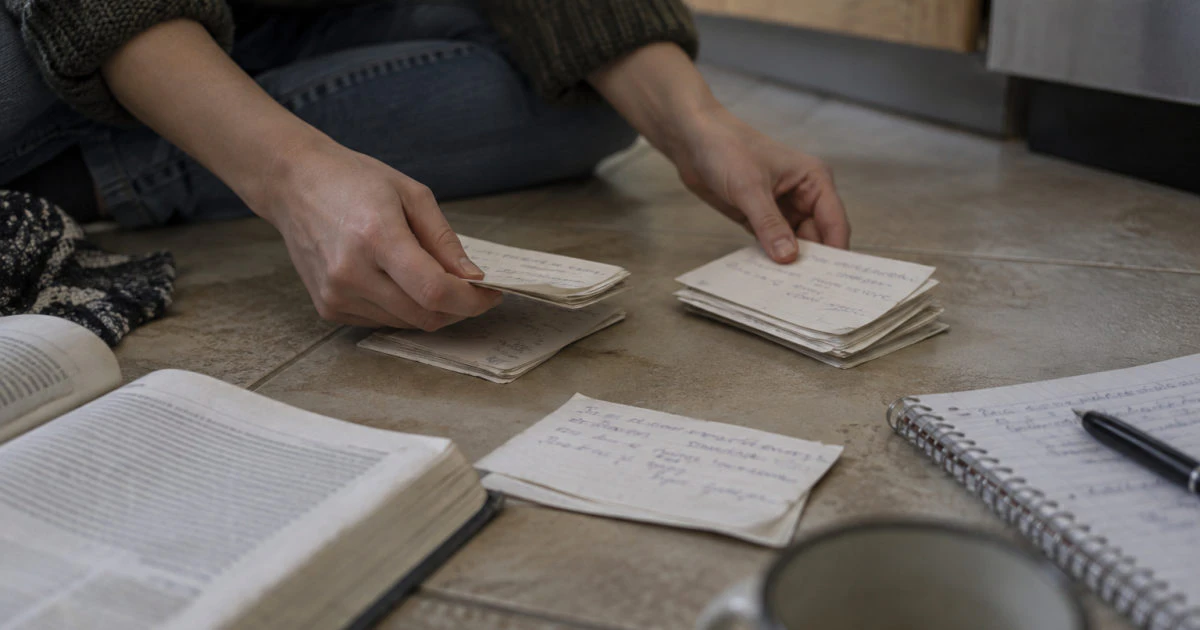
Keep the setup ordinary. You could review written flashcards while sitting on the kitchen floor, separating cards you answered correctly from those you missed. What matters is attempting the answer and returning later, not finding the perfect study location.
If you miss a review, resume rather than restarting the whole system. Prioritize important topics you are struggling with, and shorten the session if necessary. A plan you can continue is more useful than an elaborate schedule you abandon.
Use a final review without making it your whole plan
Cramming vs spaced repetition does not have to become an all-or-nothing choice. If you have studied across several weeks, a focused final review can still be useful. Use it to connect topics, practice under exam conditions, and check mistakes that have kept returning.
The difference is what that final session is carrying. After spaced practice, it refreshes and tests knowledge you have already worked with. After weeks of avoidance, it has to handle first exposure, understanding, memorization, and application at once.
If preparing review materials is slowing you down, AtomAI's Study mode can turn a document into flashcards. Check the cards against your source, revise unclear prompts, and add application questions where needed. Generating cards is preparation; answering them and returning to them is the study.
Keep reading
- Set up a simple spaced repetition system without an app.
- Choose what to prioritize the night before an exam.
- Write flashcards that make you retrieve an answer.
Have a document ready to review? Use AtomAI's Study mode to turn it into flashcards, then check them before your first practice session. Try AtomAI free
Cramming is a practical fallback when time is short, not a reliable substitute for returning to material over time. Spaced repetition is the better default for lasting recall, but it still needs useful questions, honest checking, and practice that matches your exam.
Choose your next step from the time you actually have. If the test is tomorrow, target your biggest important gaps. If you have longer, schedule another attempt after a gap—and start by checking what you can remember.