
You can know every definition in a chapter and still struggle with the exam. You can also work through a pile of practice questions without remembering the facts you need to answer them. The problem is not necessarily your effort. You may be practicing only one part of the task.
The useful answer to flashcards vs practice questions is not that one always wins. Flashcards are usually a good fit for recalling specific information. Practice questions are usually a better fit for choosing an approach, applying knowledge, and building a complete answer. Your exam may require both.
Start with what you need to do without help, then choose the method that makes you practice that action.
Compare the task, not just the format
A flashcard gives you a prompt on one side and an answer on the other. A practice question asks you to produce or select an answer, often with several steps or a longer explanation. Both can involve active recall: trying to retrieve information before looking at the answer.
The boundary is not absolute. A flashcard asking you to explain why a process occurs can test understanding. A practice question asking for a definition may test little beyond recall. What matters is what you actually do when you answer.
Look at a sample exam, assignment rubric, or your instructor's learning objectives. Do you need to name structures, compare theories, solve unfamiliar problems, or defend an argument? Your study tasks should reflect those demands. Remembering the ingredients is useful, but it is not the same as preparing the whole answer.
Use flashcards for knowledge you need ready
Flashcards work well when you need to recall a manageable piece of information: a term, a formula, a condition, a distinction, or a step in a process. They let you isolate something you keep forgetting instead of rereading an entire chapter to find it.
Keep each card focused enough that you can judge your answer. “What do you know about enzymes?” is difficult to grade honestly. “How does a competitive inhibitor affect an enzyme's active site?” gives you a clearer target. Say or write your answer before turning the card over.
Avoid putting a paragraph on the back and accepting a vague sense of familiarity as success. Decide which points your answer must contain. If you miss an essential condition or reverse a relationship, count that as something to review.
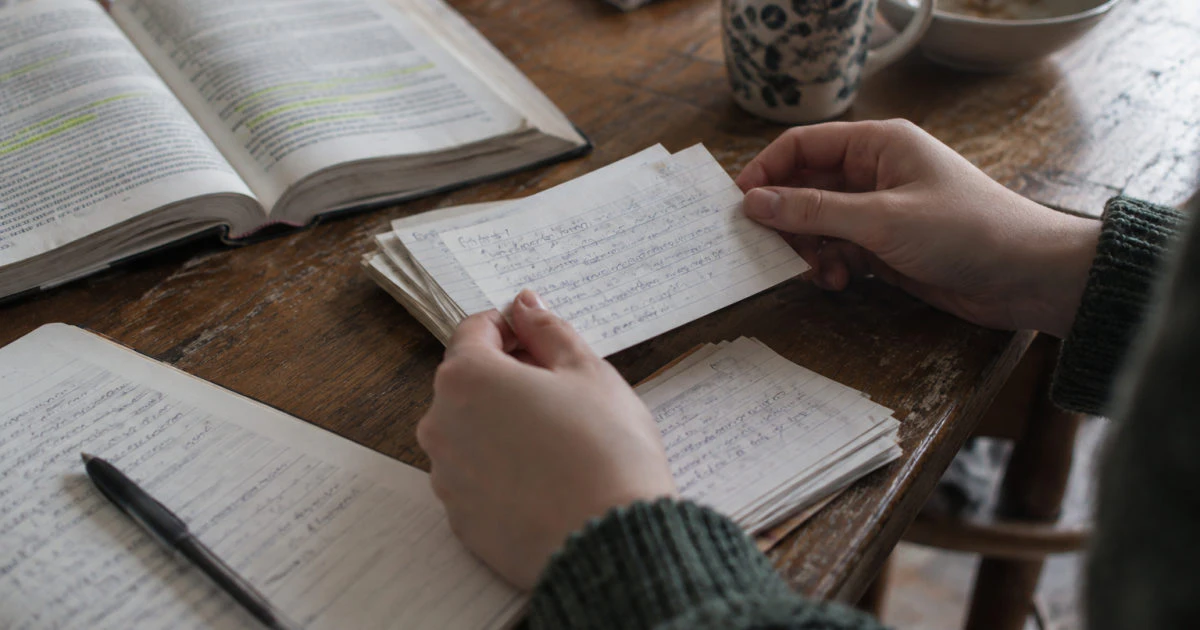
At a kitchen table, a small stack of written cards beside a highlighted textbook can be enough for a focused recall session. Check uncertain answers against the source, then revisit missed cards on another day. Do not keep repeating only the cards that feel easy.
Use practice questions to put knowledge to work
Practice questions are valuable when the difficulty lies in deciding what to do with information. A math problem might require you to choose a formula, rearrange it, convert units, and check whether the result makes sense. Recalling the formula covers only part of that work.
For an essay exam, practice might mean drafting a short argument with evidence rather than memorizing a model paragraph. For a case-based exam, it might mean identifying relevant details and explaining why they support your answer. Use questions that resemble the demands of your assessment, not just its subject.
Attempt the question before reading the solution. If you get stuck, note where: interpreting the prompt, selecting an approach, recalling information, or carrying out the steps. Then use the smallest hint you need and finish the attempt.
Check your work against a reliable solution, rubric, or course material. A correct final answer reached through faulty reasoning still needs attention. After reviewing an error, try the question again later without the solution, then attempt a different question that requires the same idea.
Choose based on what keeps going wrong
- You forget facts or definitions. Use focused flashcards, then check whether you can recall the same information inside a larger question.
- You remember formulas but choose the wrong one. Prioritize mixed practice questions. Explain why each approach fits before you start calculating.
- You recognize answers but cannot produce them. Answer without options first, whether you are using cards or questions. Recognition alone may hide a recall gap.
- You know the content but write incomplete answers. Practice full responses and compare them with the rubric. Look for missing explanations, evidence, or links between ideas.
- You run out of exam time. Try timed practice once you can complete the task accurately without a time limit. Flashcard speed does not tell you how quickly you can construct a full answer.
Combine them around your mistakes
You do not need a fixed split between the two methods. A useful flashcards vs practice questions routine starts with a representative question and lets your mistakes guide the next step.
Suppose you are working on a speed problem. You remember that speed equals distance divided by time, but you use minutes where the answer requires hours. Another card that only asks for the formula will not address the mistake. A card asking what must be checked about units before substitution is more relevant. You still need another problem to practice doing that check.
In a library study area, keep your attempted questions and a part-filled notebook together. Record the error in plain language: “I used inconsistent units,” not “I am bad at physics.” Make a card if the gap is a fact, rule, or distinction. If the gap is choosing or executing a method, find another question.
Return to the full task after reviewing the gap. Otherwise, you may improve at answering isolated prompts without finding out whether your exam performance has changed.

Check progress with a fresh task
Neither a shrinking flashcard pile nor a completed question set proves that you are ready. You may remember a card's wording or a solution's sequence rather than the underlying idea.
Check yourself with a question you have not recently seen, without notes. Can you recall the necessary information, select an approach, and explain your answer? If not, identify the specific gap and adjust your next session. Keep some recall practice when application dominates, and some application practice when memorization dominates.
If preparing cards is taking more time than answering them, AtomAI's Study mode can turn a document into flashcards. Treat those cards as a starting point: check them against your course material, edit unclear prompts, and keep only what supports your learning goals. Making the cards is preparation; answering them without looking is the practice.
Keep reading
- Make your flashcards require a real answer, not just recognition.
- Apply active recall to math and other problem-based subjects.
- Space your reviews with a simple system you can use without an app.
Want a starting set of cards from your course document? Try AtomAI's Study mode, then check the cards and pair them with relevant practice questions. Try AtomAI free
For flashcards vs practice questions, choose by the skill you need next. Use cards to make essential knowledge available without notes. Use questions to practice selecting, applying, and explaining that knowledge.
If you are unsure where to start, attempt one exam-style question. Let the mistake tell you what to review, then return to another full question. That gives both methods a clear job.