
Your results section tells the reader what happened. Your discussion tells them what to make of it. That distinction is the key to learning how to write a lab report discussion: instead of walking through every measurement again, you use the most relevant findings to answer the lab question and explain how confident you are in that answer.
Unexpected results belong in that explanation. You do not need to make every reading fit your hypothesis or find a definite cause for every odd value. You do need to show what did not match your prediction, what you checked, and whether the mismatch changes your conclusion.
Start by answering the lab question
Before you draft, put your lab manual next to your notebook. Find the question or hypothesis in the manual, then mark the result in your notes that most directly addresses it. Ask yourself: If the reader remembers only one thing about this experiment, what should it be? Put that answer in your opening paragraph and point to the relevant figure or table if your report has one.
Suppose your lab tested whether a lid slows the cooling of warm water. If the covered cup lost less heat over the same observation period, say that the covered cup cooled less overall under the conditions you tested. That answers the question without implying that the covered cup cooled more slowly in every interval or that any lid would have the same effect.
Check your assignment instructions before settling on the structure. Your instructor might ask you to address each hypothesis separately, compare your results with a published value, or combine results and discussion. The headings can change, but the job stays the same: connect what you observed to what you can conclude.

Explain the pattern without repeating the results
Once you have stated the main finding, explain why it might make sense. In the cooling example, the covered cup's smaller temperature drop is consistent with the lid restricting evaporation. But if you measured only water temperature, you did not measure evaporation directly. The lid may also have changed how air moved over the water. Present the mechanism as an explanation consistent with the evidence, not as something the experiment established on its own.
If you are comparing your results with a textbook, lab manual, or article, name the specific prediction that agrees or disagrees with your findings and cite the source as your instructor requires. If a published experiment used different containers or starting temperatures, say why that difference matters before treating the two results as directly comparable.
Show what an unexpected result changes
Imagine the covered cup cooled less overall but showed a larger temperature drop than the uncovered cup during one interval. State both findings. The larger drop qualifies the claim about what happened during individual intervals, but it does not reverse the full-period comparison. If the covered cup had instead cooled more over the full period, that would contradict the main prediction under the conditions you tested. Your discussion should say so plainly.
Check the original entries, units, timestamps, and calculations before proposing a cause. If your notes say the probe shifted during the unusual interval, you can explain how the change in placement might have affected the reading. If the notes say nothing about the probe, do not write as though it moved. It is fine to say that the records do not establish a cause.
Do not discard a reading just because it conflicts with the hypothesis. If you can verify a transcription mistake, correct it from the original record. If you exclude a reading under a documented quality criterion, report the exclusion and explain whether it changes the interpretation.
Give your unexpected result its own short paragraph
- Name the mismatch. State the prediction, then identify the observation that differed. Say whether it was a single reading, a pattern across several readings, or the opposite of the overall prediction.
- Separate checks from explanations. Tell the reader what you verified in the records. If you offer a possible explanation, indicate what evidence supports it or what information you would need to test it.
- Update the claim. Decide whether the mismatch narrows your conclusion, makes it uncertain, or contradicts it. Revise the opening claim if it is stronger than the full set of results supports.
Tie each limitation to a specific improvement
A useful limitation tells the reader what the procedure made hard to distinguish. Instead of writing “human error may have affected the results,” explain that inconsistent probe depth could make readings less comparable if the water temperature varied with depth. Unless your notes show which readings were affected, do not claim the issue pushed the measurements in a particular direction.
Then propose a change that addresses that limitation. Fixing both probes at the same depth would make placement more consistent. Repeating the comparison under matching conditions would help you check whether the unusual interval was reproducible. These improvements answer different questions, so choose the one that fits the uncertainty you identified.
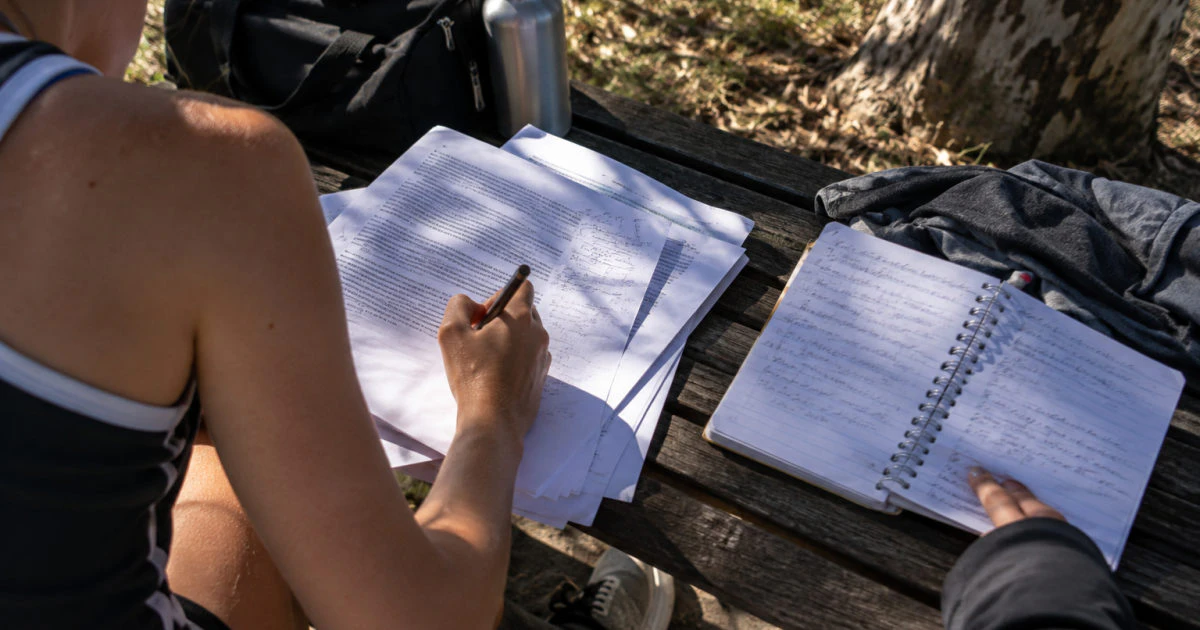
For a final check, lay your printed draft beside your lab notebook. Underline each sentence that explains a cause, and look for the observation that backs it up. If you cannot find support, label the explanation as a possibility or remove it.
Keep reading
- Check whether a source is credible before using it to explain a result.
- Learn to paraphrase a source accurately when comparing its findings with yours.
Use AtomAI’s Write mode to review your discussion for claims that sound stronger than your evidence. Check any suggested edits against your lab notes before keeping them. Try AtomAI free
A good lab report discussion gives the reader a clear answer and shows where that answer stops. Lead with the main pattern, explain it using evidence you actually collected, and give unexpected results enough space to show what they change. If a result remains unexplained after you check your records, say what you still do not know. That is more useful than a tidy explanation your data cannot support.